
Street Legal Golf Carts: What Actually Makes One Road-Legal
The full federal equipment checklist, the 25 mph rule, and why fitting lights to a golf cart doesn't make it street legal. Updated for 2026.
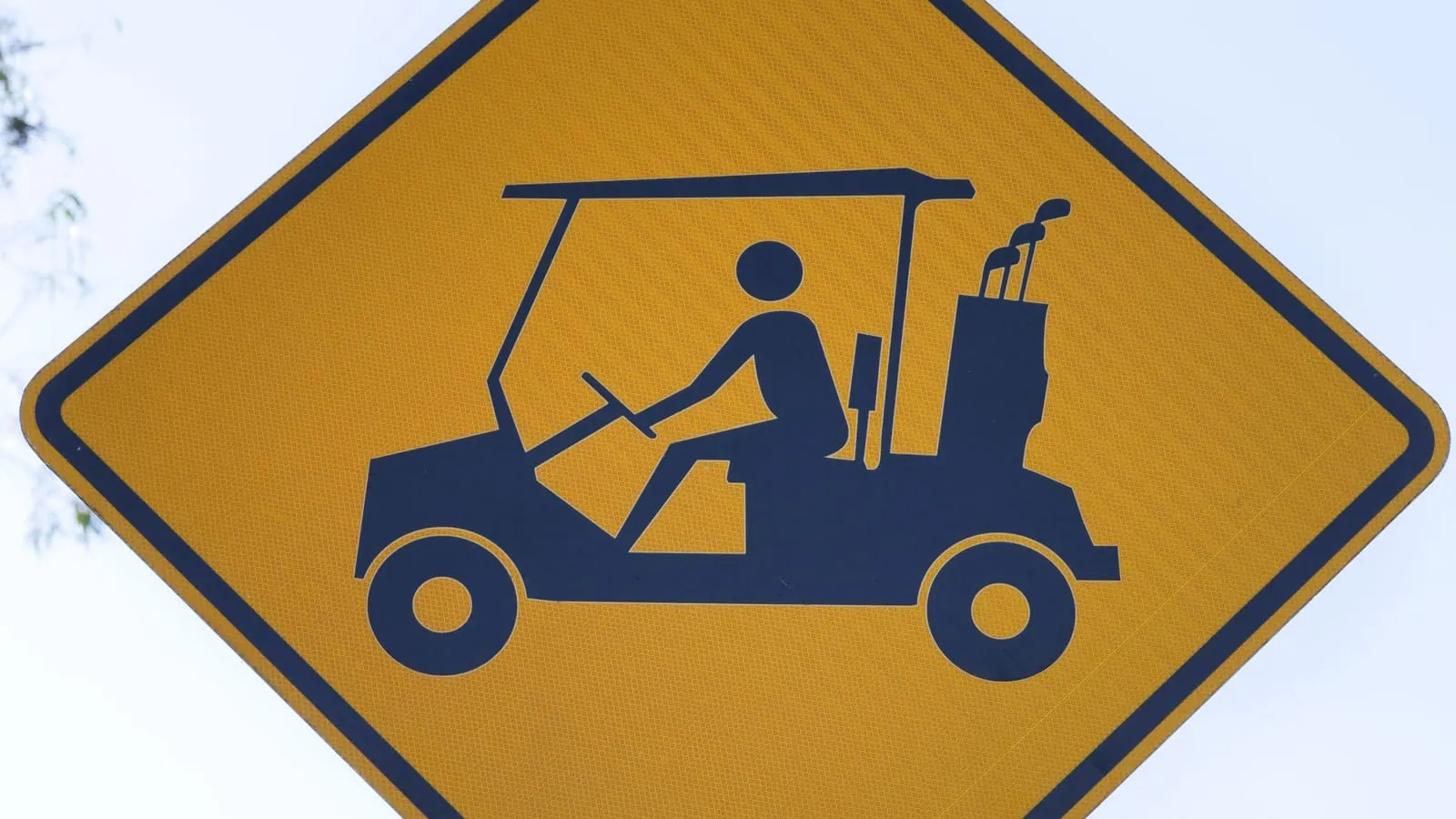
The street legal golf cart requirements that matter are federal, not manufacturer marketing. A cart is road-legal when it meets the definition of a Low Speed Vehicle (LSV) and is registered as one — and a surprising number of carts sold as "street ready" don't meet that bar at all.
Here's the actual checklist, the speed rule that catches people out, and why a conversion kit alone usually isn't enough.
Golf cart vs LSV: the distinction that decides everything
This single distinction determines whether you can legally drive on a public road, and most confusion starts here.
| Golf cart | Low Speed Vehicle (LSV) | |
|---|---|---|
| Top speed | Typically 15–20 mph | Must exceed 20 mph, capped at 25 mph |
| Federal standard | None | FMVSS 500 |
| VIN | No | Required, 17 digits |
| Registration | No | Yes, in most states |
| Where you can drive | Private property, designated paths | Public roads posted 35 mph or less |
The key point: LSV is a federal vehicle classification, not a description of how a cart is equipped. A cart that has been fitted with lights and mirrors but was never manufactured or certified as an LSV — and has no VIN — is still a golf cart in the eyes of your state DMV.
The federal equipment checklist
To be certified as an LSV under FMVSS 500, a vehicle must have all of the following:
- DOT-approved headlamps
- Tail lamps
- Stop lamps (brake lights)
- Front, rear and side reflex reflectors
- Turn signal lamps
- An exterior mirror on the driver's side, plus either an interior mirror or a passenger-side exterior mirror
- A parking brake
- A windshield meeting the federal glazing standard
- A seat belt at every designated seating position
- A 17-character Vehicle Identification Number
Miss any one of these and the vehicle isn't an LSV. Note the windshield requirement specifically — it has to meet the federal glazing standard, which a generic acrylic panel typically does not.
The 25 mph rule, and why it's a ceiling and a floor
An LSV must be capable of exceeding 20 mph but must not exceed 25 mph on a paved level surface. Both ends matter.
Too slow, and the vehicle doesn't qualify as an LSV at all. Too fast, and it leaves the LSV class entirely — at which point it becomes a motor vehicle subject to full federal safety standards it almost certainly can't meet.
This is why speed-unlocking a cart to 30 mph is counterproductive if road legality is your goal: it disqualifies the vehicle from the only class that makes road use possible.
All 50 states prohibit LSV operation on highways and interstates regardless of how the vehicle is equipped.
Registration, insurance and licensing
Federal law defines the vehicle. States decide everything else, and the variation is significant.
Registration and title. Most states require an LSV to be titled and registered like any other vehicle, with plates. The VIN is what makes this possible, which is why it isn't a box you can tick retroactively.
Insurance. Where LSV road use is permitted, liability insurance is typically required. If you financed the cart, your lender will require coverage regardless of what the state mandates — see our guide to golf cart insurance.
Driver's licence. Almost always required. Some states and communities set a higher minimum age than the standard driving age.
Local ordinances. Cities and counties can be more restrictive than the state. This catches people out constantly — a cart that's legal one town over may not be legal on your street.
Can I convert my existing golf cart?
Sometimes, but it depends on something most articles skip: the VIN.
Street legal kits supply the lights, signals, mirrors, belts and horn. What they cannot supply is federal certification. If your cart was manufactured as a golf cart, it has no 17-digit VIN and was never certified to FMVSS 500 — and in most states there is no straightforward process for a private owner to have one assigned afterwards.
Some states offer an inspection-and-titling route for converted vehicles; many don't. Before buying a conversion kit, call your state DMV and ask specifically whether a golf cart can be titled as an LSV in your state, and what the process requires. That one call saves people a great deal of money.
The reliable path is buying a cart that was built and certified as an LSV from the factory, which arrives with its VIN and compliance already in place.
State rules vary — a lot
Because states set registration, insurance, licensing and road access individually, the same cart can be perfectly legal in one state and not road legal at all in the next.
Florida, for instance, permits golf carts on roads posted 30 mph or less in designated areas while holding LSVs to a separate registration standard — and individual counties layer their own rules on top. We cover it in detail in Florida golf cart laws.
Whatever state you're in, verify with your DMV before you drive on a public road. Enforcement is uneven, but the liability if you're in a collision on a non-compliant vehicle is not.
What happens if you drive a non-compliant cart
Enforcement varies enormously. In many communities a golf cart on a residential street attracts no attention at all, which is exactly why people assume it must be fine. The risk isn't the routine day — it's the exception.
A traffic stop. Citations for operating an unregistered vehicle, driving without a licence where one is required, or operating outside permitted hours. Fines are modest; the inconvenience isn't.
A collision. This is the real exposure. If you're in an accident on a vehicle that wasn't legally permitted on that road, you may face liability questions well beyond the fault of the collision itself. Your insurer may decline the claim entirely if the policy excludes public-road use — see golf cart insurance.
An injured passenger. Seat belts are federally required on an LSV for a reason. A passenger injured in a cart without them, on a public road it shouldn't have been on, is the scenario that turns a minor incident into a serious financial problem.
The practical takeaway: the day-to-day probability of a citation is low, and the consequences of the one bad day are high. That asymmetry is the argument for doing it properly.
Buying a street legal cart
If road use is the point, buy for it from the start rather than converting later. Ask three questions before committing:
- Is this model certified as an LSV, and does it have a VIN? If the answer is vague, treat it as a no.
- Is it registerable in my state? The dealer should know, and should be willing to say so plainly.
- What's included versus what's extra? Some carts arrive road-ready; others need a package added.
We publish prices on every model, so you can compare on real numbers — see street legal golf carts for what to look for, or browse current inventory and prices. If you tell us your state, we can confirm which models qualify and what they need.
Where LSVs are allowed to go
Even a fully compliant, registered LSV isn't permitted everywhere:
- Permitted: public roads posted at 35 mph or less, in states allowing LSV operation
- Usually permitted: crossing a higher-speed road at a designated intersection, where state law provides for it
- Never permitted: highways, interstates, and any limited-access road, in all 50 states
- Varies locally: sidewalks, bike lanes, multi-use paths and beaches — frequently prohibited, occasionally allowed by specific ordinance
The crossing provision is worth knowing. Many states allow an LSV to cross a faster road at an intersection even though it cannot travel along it, which is often what makes a route practical at all.
Common questions
Does a street legal kit make my golf cart street legal? Not on its own. A kit supplies the equipment, but LSV status also requires federal certification and a 17-digit VIN, which most golf carts never had.
How fast can a street legal golf cart go? An LSV must be capable of more than 20 mph and no more than 25 mph. Exceeding 25 mph takes it out of the LSV class.
Can I drive an LSV on a 45 mph road? No. LSVs are limited to roads posted at 35 mph or less in most states, and are prohibited on highways and interstates everywhere.
Do I need a driver's licence? Almost always yes for public-road operation, and some communities set a higher minimum age than the state driving age.
Is a street legal golf cart the same as an NEV? Neighborhood Electric Vehicle is a commonly used term for an electric LSV. The governing classification is still LSV under FMVSS 500.
General information, last reviewed July 2026 — not legal advice. Federal standards and state law change, and county ordinances vary within states. Confirm current requirements with your state DMV before operating on public roads.