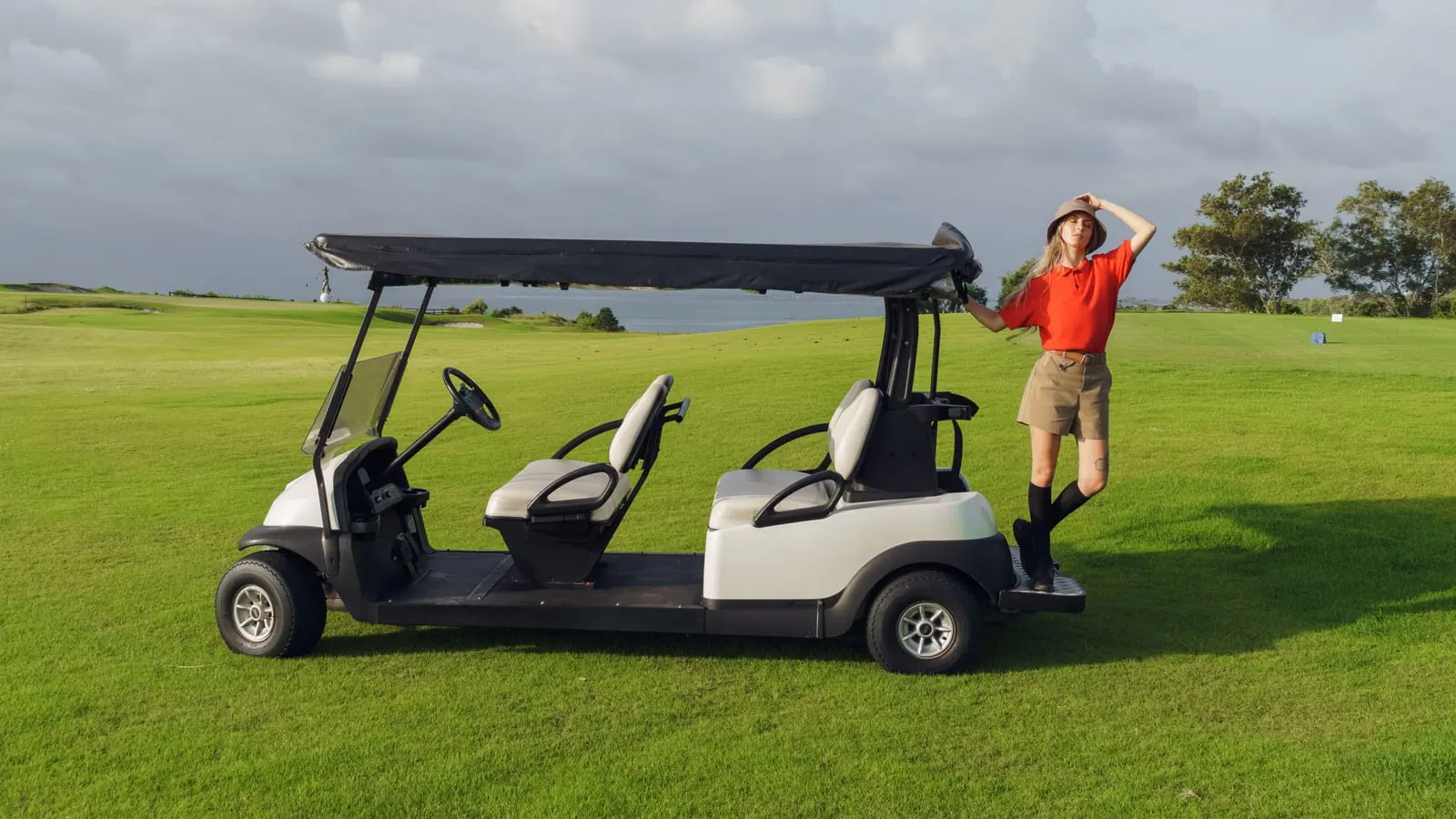
4-Seater vs 6-Seater Golf Cart: Which Size Do You Need?
Seat count affects range, handling, price and where you can park. An honest comparison to stop you buying two seats you'll use twice a year.

Choosing between a 4-seater and a 6-seater golf cart is the decision most buyers get wrong, in one specific direction: they buy for the largest group they'll ever carry rather than the group they carry weekly, and then live with a longer, heavier cart every other day of the year.
Here's what actually changes between the two, and how to pick.
The short answer
Buy a 4-seater if your normal load is two to four people, you park in a standard garage, or you drive narrow paths and tight turns. Buy a 6-seater if five or six people genuinely travel together on a regular basis, or you're running a resort, HOA or fleet where reducing shuttle trips matters.
If you're honestly between the two, the 4-seater is the safer default — it's cheaper, easier to live with, and sells faster secondhand.
Side by side
| 4-seater | 6-seater | |
|---|---|---|
| Typical layout | 2 front + 2 rear (often rear-facing) | 4 forward-facing + 2 rear |
| Length | Standard | Noticeably longer |
| Turning circle | Tighter | Wider — matters on narrow paths |
| Range per charge | Better (lighter) | Lower at the same battery capacity |
| Garage fit | Usually fits a standard bay | Often doesn't — measure first |
| Price | Lower | Premium |
| Best for | Families, couples, neighborhood use | Large families, resorts, fleets |
Where the real differences show up
Range. A 6-seater is heavier before anyone sits in it, and weight is the main enemy of range. Two carts with the same battery will not go the same distance. If you're covering real mileage, factor this in — we cover the specifics in how far an electric golf cart goes on a charge.
Manoeuvrability. The longer wheelbase is felt immediately on tight cart paths, in parking areas and reversing into a driveway. If your regular route includes narrow turns, drive a 6-seater before committing.
Storage. This is the one people discover after delivery. Many 6-seaters don't fit a standard single garage bay. Measure your space — including the door opening — before you order.
Cost of ownership. A heavier cart works its batteries, tires and brakes harder. The gap is modest, but it's real over years.
Resale. Both hold value reasonably. 4-seaters have a broader buyer pool, which usually means a faster sale.
When a 6-seater is clearly right
- Five or six people travel together most trips, not occasionally
- You're moving guests at a resort, club or community and trip count matters
- You regularly carry passengers and cargo — clubs, beach gear, tools
- You have the parking space and drive routes with room
There's a real operational argument for fleets: a 6-seater running most of the day with only two passengers aboard costs more without improving anything. One carrying six, twenty times a day, halves your trips.
When a 4-seater is clearly right
- Your usual load is two to four
- You park in a standard garage
- Narrow paths, tight turns or busy parking areas are part of your routine
- You want maximum range per charge from a given battery
- Budget matters and you'd rather put the difference into lithium or accessories
The middle option people miss
A 4-seater with a rear flip seat converts between cargo deck and two extra seats. It won't match a true 6-seater for comfort over distance, and the rear pair is rear-facing — but for occasional extra passengers it closes the gap without the length penalty.
If your six-person trips happen a handful of times a year, this is very often the right answer, and it costs less than sizing up.
Four real scenarios
Family of four in a gated community. A 4-seater, comfortably. The weekly load is four, the roads are narrow, and the garage is standard. If grandparents visit twice a year, a rear flip seat covers it.
Family of five or six. A 6-seater, if everyone genuinely travels together. If the sixth seat is one child who's usually at practice, run the numbers on a 4-seater plus flip seat first — you may be buying length for a passenger who isn't there.
Resort or club shuttling guests. A 6-seater, and possibly several. Trip count is the operational metric, and halving it is worth real money in staff time. Talk to us about fleet quotes rather than buying at retail.
Golfers. A 4-seater is standard, and for two players with bags it's ample. A 6-seater is unnecessary length on a cart path unless you're consistently playing in larger groups.
What about 2-seaters and 8-seaters?
The 4-versus-6 framing leaves out both ends of the range.
2-seaters are lighter, cheapest to buy and run, and the best range per charge. Ideal if it's genuinely you and one passenger — a couple, or a single golfer. Most buyers rule them out too quickly, then admit later that the rear seats sat empty.
8-seaters and larger exist and are primarily commercial: resorts, campuses, event venues and shuttles. They're a different vehicle class in practice, with the parking and manoeuvring constraints to match, and they're usually a fleet purchase rather than a personal one.
For personal use the honest range is two to six, and the mistake is nearly always sizing up rather than down.
What it costs
Six-passenger builds carry a genuine premium — longer frame, more battery, heavier suspension. You can see exactly where each sits in our current lineup in how much an electric golf cart costs, which pulls live prices by seat count.
If the 6-seater you want stretches the budget, financing spreads it, and used inventory is worth checking — larger carts often come up secondhand from resorts and communities.
What to check on a test drive
Seat count is easy to compare on paper and much easier to judge in person. If you can drive both, check these specifically:
The tightest turn on your route. Not the showroom forecourt — think of the sharpest corner you take regularly and whether the longer cart clears it.
Reversing. A longer cart is harder to place, and rear visibility past a loaded back seat is worse than people anticipate.
Rear seat access. Getting in and out of the third row on a 6-seater varies a lot between models. If older passengers or children will use it regularly, try it rather than assuming.
Ride quality loaded. An empty cart tells you little. A 6-seater carrying two people rides differently from one carrying six, and the rear axle is where you'll notice it.
Hill performance with a full load. If you have any gradient at all, this is the test that matters. A fully loaded 6-seater on a hill is the hardest thing you'll ask of the drivetrain.
Braking distance loaded. More weight, more distance. Worth feeling once, deliberately, before it matters.
How to decide in five minutes
- Count your typical trip, not your maximum.
- Measure your garage bay, including door width.
- Walk your most common route and find the tightest turn.
- Decide whether occasional extra passengers justify permanent extra length — or whether a flip seat covers it.
- Compare real prices for both in current inventory and see what the monthly difference actually is.
Step four is where most of the value sits. The question isn't "could I ever need six seats?" — it's "do I need six seats often enough to drive a longer cart every day?"
Common questions
Can a 6-seater golf cart fit in a garage? Often not in a standard single bay. Measure before ordering — length and door opening both matter.
Is a 6-seater slower than a 4-seater? Top speed is usually similar, but acceleration and hill climbing are affected by the extra weight, especially fully loaded.
Do 6-seaters have less range? Yes, all else equal — more weight means less distance per charge. A larger battery can offset it.
Are rear-facing seats safe for children? They must have seat belts fitted and used, and children should be supervised. State rules on child passengers vary — check yours.
Can I add seats to a 4-seater later? A rear flip seat can often be added. Converting a 4-seater into a true 6-seater isn't practical, as the frame length is fixed.
How much longer is a 6-seater? Meaningfully — enough that it commonly won't fit a standard single garage bay where a 4-seater will. Check the exact dimensions on the model's spec sheet against your space before ordering, including the door opening.
Does a 6-seater need a bigger battery? It needs more energy to cover the same distance because it's heavier, so models are usually specified with greater capacity. Compare the range figure rather than the battery size on its own.
Is a 6-seater harder to tow or transport? Yes. The extra length and weight affect trailer choice and delivery cost. Worth confirming with us before you order if transport is part of your plan.
Specifications vary by model. Check the spec sheet on the individual model page for exact dimensions, capacity and range before ordering.